Can U.S. Compete With China? Washington Establishment Has Serious Qualms

Courtesy of Global Times

April 20, 2025

China’s superiority has to be countered by a new, advanced coalition of the United States with its allies around the world, according to a just published article in Foreign Affairs, by Kurt Campbell, and Rush Doshi. Underestimating China

I will summarize their essential argument, which is grounded in the flawed axioms of the rules based order and its perverted zero-sum mentality. In brief: 1) China’s superiority over the U.S. has to be acknowledged; 2) China can only be effectively thwarted by a new type of alliance led by the U.S.; 3) U.S. cannot lead such an alliance under President Trump’s current diplomacy.

They argue that the U.S. is weaker than China in vital categories of military and economic capacity, and the West needs a new type of collective strategy with its international partners to respond to China’s hegemony.

This paper was published on April 10, after the imprint of President Donald Trump, but before the consequences of his so called tariff “Liberation Day.” It is more than a wake-up call for the rules-based order, which is already suffering from severe political and financial crises. With brutal honesty and a cache of devastating statistics, the authors attempt to break through any delusions about China’s dominance.

China’s Superiority

They write:

China will remain vastly more powerful than any past U.S. competitor on metrics most relevant for competition…China is the first to outmatch the United States in size alone as well as in several strategically relevant areas…Beijing will remain more formidable than any past challenger.

The greatest risk is not declinism: it is complacency, leading to a lack of strategic intention and a failure to catalyze action to rise to the China challenge. If anything, the United States–particularly in the era of President Trump–risks overestimating unilateral power and underestimating China’s ability to counter it.

The authors’ thesis is that in great power competition, scale and capacity matter-quantity has a quality all its own. That the U.S. cannot catch up to China’s advantage in scale by itself…its only viable path lies in coalition with others.

They warn Trump; it would be particularly unwise to go-it alone in a complex global competition. By retreating to its sphere of influence in the Western Hemisphere, the United States would cede the rest of the world to a globally engaged China.

This warning, published in the Anglo-American Establishment’s premier magazine, exposes a challenge for the rules-based order that is unsolvable owing to their ideologically flawed world view. Viewing nations as victors and victims, the mighty and the less mighty, in a zero-sum fixed world, the political-financial elites wrongly perceive China as an enemy whose development must be contained, if not suppressed.

Contrary to the prejudices and false beliefs that dominate the believers of the rules-based order, the universe is not fixed; but actually, growing and expanding. Nations are composed of human beings, who are uniquely endowed with the potential for creative thought. Human-cognitive intervention in the physical universe changes the world in which we live. All nations have a shared interest in providing for the physical and spiritual needs of their citizens, who are universally indistinguishable in their common innate creative power. This understanding of the commonality of human creative thought is overlooked by the overwhelming majority of political leaders and the world’s population but is the secret to all successful foreign and domestic policies.

Courtesy caixinglobal.com

The authors insist that if Washington and its allies are going to triumph over China, they must not risk:

underestimating both the latent and actual power of the only competitor in a century whose GDP has surpassed 70% of that of the United States. On critical metrics, China has already outmatched the United States. Economically, it boasts twice the manufacturing capacity of the United States. Technologically, it dominates everything from electric vehicles to fourth-generation nuclear reactors and now produces more active patents and top-cited scientific publications annually. Militarily, it features the world’s largest Navy, bolstered by shipbuilding capacity 200 times as large as that of the United States; vastly greater missile stocks; and the world’s most advanced hypersonic capabilities

Washington is filled with seminars and papers by numerous think tanks, that believe inherent weaknesses in China will undermine their future dominance. However, Campbell and Doshi warn: Emphasizing China’s weaknesses risk understating its scale and capacity on the metrics and time frame most relevant for great power competition.

In their attempt to make sure this reality is not overlooked, they write, Accounting for purchasing power and local prices using the world bank’s methodology, although imperfect, reveals that China’s economy surpassed the US economy about a decade ago and is 25 percent larger today: roughly $30 trillion to the United States’ $24 trillion.

Courtesy of andrewbatson.com

China’s Advantage in Physical Economy

China’s phenomenal economic growth that includes lifting almost one billion Chinese out of poverty over the last two generations is the result of their commitment to expanding their manufacturing sector, and large investments infrastructure. Washington chose the opposite policy of deindustrialization, and transformed the U.S. into a service economy, over the same period of time.

The authors provide an astonishing comparison between the physical economy of China and the U.S.

…if one looks narrowly at goods rather than services, China’s productive capacity is three times as large as that of the United States–a decisive advantage in military and technological competition–and exceeds that of the next nine countries combined. In the last two decades after China joined the World Trade Organization, its share of global manufacturing quintupled to 30 percent while the US share halved to roughly 15 percent; the United Nations has estimated that by 2030 the imbalance will grow to 45 percent and 11 percent. China leads in many traditional industries–producing 20 times as much cement, 13 times as much steel, three times as many cars, and twice as much power as the United States…China is also a decade ahead of anyone else in commercializing fourth-generation nuclear technology with plans to build over 100 reactors in 20 years. The last great power to so thoroughly dominate global production was the United States, from the 1870s to the 1940s.

The authors calculate that the combined economies of Australia, Canada, India, Japan, Mexico, New Zealand, the U.S., and the European Union are two to three times the size of China and produce almost half of all global manufactured products. They emphasize that unlocking the potential of this coalition should be the central task of American statecraft in this century.

Data source: U.S. Energy Information Administration and the International Atomic Energy Agency

Trump An Immediate Problem

The authors contend that Trump threatens the international alliances, which must be strengthened and upgraded to effectively counter China’s economic and military dominance. They write:

Trump has presented the United States’ partners with hard choices and outright threats. Many may understandably be loath to further tie themselves to Washington anytime soon… key U.S. allies are already considering declaring ‘independence’ from Washington–pursuing nuclear weapons, building new regional groupings, challenging the dollar’s role. Some, spurred by domestic reaction to U.S. pressure are contemplating moving closer to China, even at an enormous peril to their industries or security. The United States risks fracturing the free world and closing its path to scale.

Expressing the concerns of the Washington Establishment, they fear that under Trump:

If the United States fails to pursue scale with others, or retreats to the Western Hemisphere while undoing its alliances, the contest for the next century will be China’s to lose… The result will be a United States that is weaker, poorer, and less influential–and a world in which China sets the rules…Success requires going much further with greater ambition than the alliance-friendly policies of the previous Biden ministration and rejecting the outright the alienating go-it-alone ‘America First’ approach taking shape under Trump.

There is no question that President Trump has up-ended many aspects of the existing rules-based order structure. This is exemplified by pursuing peace in the three-year old Russian-Ukrainian war, freeing Russian President Putin from pariah status, and distancing the U.S. from NATO. This is of immediate concern for those advocating a U.S. led Western mobilization to scale-up  economic and military capacity to prevent China from becoming the hegemon of the world.

President Trump may succeed in disrupting the accepted norms of the Western alliance, threatening the goals of the rules-based order. However, thus far he has not displayed the leadership qualities necessary to guide the world to a new paradigm of political-economic relationships among nations.

President Trump, like all of the U.S. presidents since John F Kennedy, has no knowledge of the scientific economic principles that built the U.S. into an industrial nation. He knows the word tariff but has no understanding how tariffs were actually utilized to create an indigenous manufacturing sector from thirteen agrarian based colonies.* President Trump has built hotels, gambling casinos and was known during the time I lived in New Your City, as a real estate mogul. He, like many in his cabinet and the majority of American, believes making money is synonymous with economic growth. In fact, President Trump, like his predecessors, has no concept of the importance of creating a robust manufacturing sector, or the vital necessity of replacing the dilapidated infrastructure of the U.S., to drive real economic growth.

Courtesy of prosperousamerica.org

U.S. Self-Destruction

Any politician or American, who blames China for the economic failings of the U.S., is either grossly misinformed or simply lying.

The decision by President Nixon, in August 1971, to remove the dollar from its established mooring to gold, ended the fixed exchange rate system created at Bretton Woods. This ushered in an orgy of monetary speculation over the succeeding years,  creating a monetary bubble divorced from the physical economy. This ill-fated decision was the beginning of the transformation of the Western financial system into a gigantic gambling casino.

In less than a decade later, the U.S. launched the contraction of its all-important manufacturing sector. Beginning in 1979, about the time China commenced its “opening-up” strategy, the U.S. financial-political establishment adopted the insane concept of transforming America’s industrial economy into a “post-industrial society.” Opposite to China, the U.S. intentionally reduced its manufacturing-industrial component. The U.S. became a consumer society with the service sector becoming the primary employer, living off of commodities produced by cheap labor from poorer nations; otherwise known as globalization. Although some services are necessary for the functioning of society, services do not produce physical wealth. Hence, the very notion of “service industries” is a misnomer.

Examine the decline of the last forty-five years of employment in the U.S. manufacturing sector. The facts speak for themselves.

Manufacturing jobs peaked in June 1979, at 19.6 million out of 90.1 million total non-farm jobs-(22%). Two generations later, in June 2019, manufacturing employment dropped to 12.8 million out of a total 150.7 million non-farm employment (8.5%). A decline of 6.7 million jobs or 35 perce­nt from forty years earlier. A direct result of the post-industrial utopian fantasy. From 1979 to 2019, not only did the level of manufacturing jobs decrease by over one third, but of great consequence for the economy, the percentage of manufacturing jobs to total non-farm employment decreased by over 60 percent. In analyzing the physical economy, this means that a shrinking number of manufacturing operatives were supporting an increasing number of total employed workers and within an expanding population. A recipe for disaster, which continues today. After the huge decline during the Covid-19 period, manufacturing employment recovered to only 12.9 million in December 2024, barely above the 2019 level and still 35 percent below manufacturing employment in 1979.

From 1979-2019, employment in all categories of the service sector increased. This includes employment in trade, transportation, information, utilities, professional business, and financial services.

If one adds up the federal debt, consumer debt, school debt, state debt, mortgage debt-all public and private debt-the total approaches $100 trillion in U.S. indebtedness. Presently the U.S. economy is built on a house of cards. A whopping 70% of the U.S. GDP consists of consumer spending. Without credit cards the U.S. economy would cease to exist.

This essay is a call to arms to mobilize the rules-based order to maintain their supremacy. However, to challenge China on the global stage in the years ahead requires reversing decades of self-destruction by the U.S. Do the so called wise men of the Anglo-American Establishment have the intelligence and resolve to reach back into America’s history to discover the scientific-economic principles that actually built the United States into an industrial power.** However, should the goal merely be to neutralize China, or should the U.S. endeavor to achieve a more noble mission? To wit: collaborate with China to finally end poverty and hunger in every nation on this planet, thus ensuring durable peace and security throughout the world. Through cooperation, the two economic superpowers could change the future of our civilization for generations to come. This would require an end to the rules-based order and the creation of a new financial architecture committed to global growth of the physical economy. Now is the time to begin preparing for this new paradigm.

*Nancy Spannaus, Hamilton versus Wall Street: The Core Principles of the American System of Economics 

** Anton Chaitkin, Who We Are: America’s Fight for Universal Progress, from Franklin to Kennedy: Volume I -1750s to 1850s 

Read below my earlier post:

U.S. Establishment Admits Truth Of China’s Economic Superiority, But They Don’t Understand It

China & BRICS Choose Progress Over West’s Deindustrialization

Will Trump Bash China & BRICS in Africa or Promote Joint Economic Growth?

Lawrence Freeman is a Political-Economic Analyst for Africa, who has been involved in economic development policies for Africa for 35 years. He is a teacher, writer, public speaker, consultant on Africa, and an analyst of global strategic relations. Mr. Freeman strongly believes that economic development is an essential human right. He is the creator of the blog: lawrencefreemanafricaandtheworld.com, also publishes on: lawrencefreeman.substack.com, “Freeman’s Africa and the World, and on X @lkfreemansafrica

U.S. Establishment Admits Truth Of China’s Economic Superiority, But They Don’t Understand It

U.S. President, Donald Trump and Chinese President, Xi Jinping (courtesy of sutori.com)

April 7, 2025

Unintentionally, the rules-based international order not only reveals its weakness in regard to China, but also the failure of the U.S. economy due to its intrinsic flaws. If one knows the true history of the United States, as I do, Michael Froman’s Foreign Affairs article, China Has Already Remade the International System, exposes the strategic challenge-paradox the U.S. faces today. To compete with China, the U.S. would have to reindustrialize its economy, but that would run counter to the free-trade financial predatory nature of the rules-based order. The author discloses the complete absence of knowledge by the present day financial-political elites, of the scientific principles responsible for the creation of the formerly industrialized United States

We should not lose sight of the fact that Foreign Affairs is published by the Council on Foreign Relations, the century old British American policy institute that represents the thinking of the Anglo-American Establishment in the U.S.

The American System

President Trump, like his predecessors for the last sixty years, has no understanding of how the United States was created from thirteen colonies into a powerful industrial nation. It was accomplished under the guidance of Alexander Hamilton’s principles for economic growth, which later became known as the American System of Political Economy. While tariffs were one aspect of Hamilton’s policy, they are misunderstood and misapplied today. Hamilton and his followers; Fredrich List, Henry Carey, John Quincy Adams, Abraham Lincoln, William McKinley, and Franklin Roosevelt, rejected the free trade mentality that dominates conventional economic thought today. Read my article: Nations Must Study Alexander Hamilton’s Principles of Political Economy.

Architects of the American System of the Political Economy in the 18th and 19th centuries (courtesy of schillerinstitute.com)

Froman’s argument is: China was let into the Western world order, but then violated the rules to emerge from an undeveloped peasant based economy to a robust manufacturing industrialized economic power. China’s crimes, in the eyes of the rules-based order are: not allowing the so called markets to determine the future growth of its economy. As Hamilton and other more thoughtful founding fathers knew, Adam Smith’s theories, and the so called freedom of the marketplace, were always a fraud. The marketplace was never “free,” and it never resulted in the development of an economically sovereign nation. The United States, like every other modern nation that emerged in the last four hundred years, always entailed the intervention of the state, and the practice of dirigisme (state directed credit)  policies.

Historian Nancy Spannaus summarizes the core principles of the American System: That principle is the use of government-regulated credit to promote continuous scientific and technological progress through the constant upgrading of the productive powers (mental as well as physical) of the labor force. These principles conflict sharply with the laissez-faire ideas which most Americans have been told built our economic prosperity. americansystemnow.com

It is not mysterious to understand how China has transformed its economy in less than fifty years. Practitioners of the American System of Political Economy have done the same, when in charge of crafting U.S. economic policy. Tariffs or protectionism have not been historically applied simply to make money or as a political weapon against other nations, as many foolishly think today. The profitability of the American System that includes tariffs flows from a full throated commitment to industrialize the nation. This would include:

  • Increasing the productivity of the economy and workforce
  • Expanding the manufacturing sector
  • Modernizing the agricultural sector
  • Issuing low-interest public credit for investments in infrastructure
  • Promoting advances in science and technology
  • Upgrading educational standards
  • Providing quality healthcare
  • Formulating a vision for great infrastructure projects

The objective of such commitments is not to make money per se. It is to raise the standard of living of the nation’s citizens, eliminate poverty and increase the longevity of life. All of which China has accomplished in approximately two generations.

Paul Volker, Chairman of the Federal Reserve from 1979-1987, ushered in the destruction of the U.S. manufacturing economy. (courtesy of jacobin.com)

U.S. Chooses Deindustrialization

In 1971, several years before China’s Deng Xiaoping launched the modernization of China, President Nixon removed the dollar from being a gold based currency. This began the process of transforming the financial system into a gigantic gambling casino, disconnected from the physical economy. Not only is the Western financial system bloated with trillions of dollars of debt, but it also contains almost two quadrillion dollars of derivatives, which are gambling bets. The truth, which Froman does not know or will not tell, is that the rules-based order is grounded on a predatory monetarist system, which exists to exploit its financial supremacy. Their objective is to obtain and maintain political power, not create wealth for the material improvement of people’s lives.

The United States and the West has been going in the wrong direction for decades, and now they are faced with the reality of what China has accomplished in becoming an industrialized and manufacturing powerhouse. The immediate conundrum for the United States is: 1) not understanding how China achieved their level of economic success; 2) not knowing how to apply or even knowledge of the principles of the American System; and 3) not having any intention of giving up their financial-predatory mindset.

The insanity of the U.S. elites, reflecting their opposition to expanding the industrial economy of the U.S., is best exemplified by their commitment to “deindustrialization” in the 1980s. Much of this was accomplished by Paul Volker, then head of the Federal Reserve, who raised interest rates to 20% in June of 1981, suffocating the economy in his pursuit of “controlled disintegration.” Volcker’s policy shut down industry, pauperized the American consumer, only helping banks, insurance companies, brokerage firms, and money managers to make higher profits.

The political-financial elites, who actually determine U.S. economic policy intended to transform the U.S. into a “post-industrial society.” Their fantasy ridden belief was that America no longer needed a strong manufacturing sector. They intended the U.S. to become a service economy and the center of the Western financial system, surviving by purchasing cheap products from around the world. They succeeded. Tourism replaced production. The U.S. has never recovered. We witnessed the effects of this dangerous policy during the Covid 19 crisis, when the US could not produce the essential products required for the health care of its citizens.

Compare China’s policy from the 1980s forward, to expand and industrialize their economy, to that of the U.S., to contract its industrial manufacturing base.

One example that typifies the drastic difference in orientation between China and the U.S. over the last two generations, is their transportation systems. China’s high-speed rail trains travel smoothly at 215 miles an hour, compared to the antiquated U.S. Amtrak trains which plod along at an average speed of 48 miles per hour. Think about the effect of that order of magnitude difference in speed has on the productivity of an economy?

China Rejected West’s Rue-Based Order

(Courtesy of statista.com)

Froman believes falsely that President Trump’s policies will succeed in rebuilding the U.S. economy. He bemoans the fact that Washington failed miserably to induce China into becoming a member of the rules-based order, refusing to submit to their free trade ideology diktats. He whines that China ignored Washington’s demands that the Chinese government stop subsidizing the production and exports of goods, which distorted the global marketplace.

He writes:

The U.S. strategy of engagement with China based on the premise that, if the United States incorporated China into the global rules-based system, China would become more like the United States…Instead of China coming to resemble the United States, the United States is behaving more like China (sic). Washington may have forged the open, liberal rules based order, but China has defined its next phase: protectionism, subsidization, restrictions on foreign investment, and industrial policy. To argue the United States must reassert its leadership to preserve the rules-based system it established is to miss the point. China’s nationalist state capitalism now dominates the international economic order.

Although Froman is acutely aware of China’s growth as an economic power in the 21st century, he has no idea how it happened. He appears clueless as to the effective policies that China employed to raise almost one billion people out of poverty, erroneously attributing the cause to globalization. China rejected the Western dictated norms of behavior, crushing the fantasies of the rules-based order that they would control China’s future.

China The New Model?

Froman continues:

The country’s [China’s] GDP grew from $34.77 billion in 1989, to $1.66 trillion by 2003, to $17.79 trillion in 2023. Hopes were high that integrating China into the rules based trading system would lead to a more peaceful and prosperous world… In 2004, China made-up 9% of the world’s manufacturing value added, leapfrogging to a massive 29% in 2023.

Over a period of 34 years, China’s GDP grew a whopping 500 times,  according to the World Bank.

Froman makes the laughable analysis that President Trump is now chosen the option of becoming like China. The problem is, that neither President Trump nor any of his advisors comprehend the strategy that China adopted to build its economy. Their difficulty is compounded by their failure to comprehend or have any knowledge, of the American System of Political Economy, as practiced over centuries in the United States.

Froman points out that the proportion of the U.S. labor force employed in manufacturing has been declining for decades. However, it will not be reversed simply through President Trump’s misguided tariff policy. Froman, displaying his ignorance of American history, asserts that China has pioneered a new economic model, characterized by protectionism, constraints on foreign investment, subsidies, and industrial policy–essentially nationalist state capitalism. These policies by the government of China parallel the measures enacted by the United States when it was employing the principles embedded in the American System of Political Economy.

Froman and others, writing on behalf of the Washington Establishment, would better spend their time studying Alexander Hamilton, and his students, who understood the role of the state in nurturing industrial capitalism. They might also come to comprehend that the development of U.S. and China is not antithetical, rather both nations can expand their economies in a global system committed to economic progress.

Read my earlier posts below:

China & BRICS Choose Progress Over West’s Deindustrialization

China Not An Enemy of the US, Could Be A Partner For Global Economic Development

Lawrence Freeman is a Political-Economic Analyst for Africa, who has been involved in economic development policies for Africa for 35 years. He is a teacher, writer, public speaker, consultant on Africa, and an analyst of global strategic relations. Mr. Freeman strongly believes that economic development is an essential human right. He is the creator of the blog: lawrencefreemanafricaandtheworld.com, also publishes on: lawrencefreeman.substack.com, “Freeman’s Africa and the World,” and on X @lkfreemansafrica

America’s Self-Interest is to Generously Assist in Development of Africa

This interview was conducted on November 7, 2024, by Anton Chaitkin, antonchaitkin@substack.com author of Who-We-Are

November 12, 2024

The African continent with its projected population of 2.4 billion in the next twenty-five years, will be the center of commerce on the planet. It is in America’s interest to help African nations achieve substantially higher rates of economic growth.

The root cause of virtually all the conflicts ongoing in Africa are the result of  underdevelopment, despite having different circumstances and triggers. The continued expansion of poverty on the African continent, especially among the sub-Saharan nations, is the primary cause of unrest. Desperate, hungry, impoverished people fighting for scraps to merely survive leads to instability and conflict. The U.S., since the death of John Kennedy, has failed to join African nations in advancing their economies by investing massively in infrastructure. If the trillions of dollars spent on USAID and countered terrorism, was turned into long term-low interest loans or outright grants for infrastructure African nations would be more peaceful and prosperous.

The African continent is the least industrialized and has the largest deficit in density of infrastructure per land area and per capita. Africa today produces 1.9 percent of the world’s manufactured goods. This pitiful amount of manufacturing activity contributes to its unmatched levels of poverty. Africa’s vast uncultivated land can feed Africa and other parts of the world, if sufficient expansion in electricity, railroads, roads, and irrigation were undertaken.

China has already proven that poverty can be eliminated. If the U.S. radically altered its foreign-economic policy towards Africa and collaborated with China, it is possible to eradicate poverty and hunger on the African continent within one generation.

Read below my earlier posts:

U.S. Elections Approach: America is Better Than This Spectacle

Hard Infrastructure in Africa: Essential for Economic Growth. Development is a Human Right!

China Eliminated Poverty With Science and Infrastructure. It Can Be Done in Africa Too!

Lawrence Freeman is a Political-Economic Analyst for Africa, who has been involved in economic development policies for Africa for 35 years. He is a teacher, writer, public speaker, and consultant on Africa. Mr. Freeman strongly believes that economic development is an essential human right. He is the creator of the blog:   lawrencefreemanafricaandtheworld.com, and also publishing on: lawrencefreeman.substack.com, “Freeman’s Africa and the World.”

Will FOCAC Summit Strategize For Africa’s Future Economic Growth?

September 2, 2024

China is hosting the 9th Forum on China-Africa Cooperation (FOCAC) summit in Beijing on September 4th through September 6th. FOCAC conferences have occurred every three years since the year 2000 bringing together leaders and representatives from the African continent with their Chinese counterparts. These discussions cover all aspects of economic, political, and social relations between China and the African nations. There is no doubt, despite all the naysayers and propaganda attacks against China alleging an ulterior motive, this is a true friendship, an important feature of China’s foreign policy. China has outflanked the Western governed “rules-based international order,” creating a bond between the two giant populated regions of the world. FOCAC is unique. There is no such comparable forum between African nations and the United States or Europe.

Geopolitical Limitations

The West, led by the United States, has continually attacked China with false claims, trying to create a wedge between China and Africa. They have accused China of being the new colonial power in Africa, which is completely false. They have accused China of “debt-trap” diplomacy, which has been proven erroneous again, and again. There has not been a single project in Africa taken over by China, or any assets seized by China, because of the inability of African nations to pay their loans. Despite all these attempts to malign China, the China-Africa relationship has substantially grown in this century. China eclipsed the United States in trade with Africa in 2009. China-Africa trade has  zoomed up to approximately $282 billion, while United States trade with Africa has shrunk to less than $50 billion.

From the combination of FOCAC, and the creation in 2013 of the Belt and Road, China has contributed to massive infrastructure expansion across the continent. In summary, this includes installation of over 25 gigawatts of electricity generation capacity, constructing and upgrading over 10,000 kilometers (kms) of railways; 100,000 kms of highways; over 60,000 kms of submarine cables; almost 1,000 bridges; 100 ports; and over 100 health facilities and schools.

Such vital categories of hard and soft infrastructure were never built by the “rules-based order” in the half century in which the West dominated trade with Africa.

China-Africa Partner for Growth

The 9th FOCAC is the first summit following the disruptions caused by Covid-19. The theme of this conference is Joining Hands to Advance Modernization and Build a High-Level China-Africa Community with a Shared Future. This theme is not new. China and Africa have a history of cooperation, which continues to develop.

Soon after the 8th FOCAC in Dakar, Senegal in 2021, China released an outline of future China-Africa cooperation,  China Africa Vision 2035. In this policy paper, China outlines the key categories of cooperation for the development of the African continent. They include expansion of infrastructure, and growth in the manufacturing sector in order to achieve poverty reduction of poverty. See excerpts below.

Program for Infrastructure Development in Africa-PIDA’s Energy Impact” from the African Union’s vision statement, . (courtesy of limn.net)

 2.3 Advancing integrated cooperation. China actively participates in the development of the African Continental Free Trade Area (AfCFTA). China-Africa infrastructure cooperation is upgraded as China supports the development of African railway, highway, shipping, port, airline and communications network based on multiple cooperation models. The two sides establish diversified arrangements for trade and investment facilitation to elevate China-Africa cooperation on trade and investment facilitation to a new level.

3.2 Expanding production capacity cooperation. China will help Africa develop “Made in Africa” brands and integrate into global industrial and supply chains by assisting Africa to develop its manufacturing sector. China supports Africa in building and improving technical standard system for quality infrastructure. China will share experience with Africa to help Africa upgrade and enhance the competitiveness of its manufacturing sector, invigorate the private sector, and create more jobs in the private sector.

5.2 Notable achievements in poverty reduction cooperation. China and Africa continue to share experience in job creation and poverty reduction in various ways. China supports Africa in enhancing poverty reduction capacity, improving education, water and power supply and other public utilities, advancing urbanization, and achieving inclusive growth. With solid progress, the humanitarian exchange serves as a humanitarian bridge between China and Africa.

Achieving Economic Growth

For those of us who comprehend the true history of modern economic development, it is beyond dispute that infrastructure, especially electricity, and manufacturing are essential to achieve measurable physical economic growth. I have made the case repeatedly that without electricity (infrastructure), no nation is capable of economic growth. Read: Africans Fight Back Against Green Energy Poverty Policy of the West.

There has been much justified insistence that African nations should no longer allow their resources, especially critical minerals, to be simply extracted with little or no benefit to their economy. Now, nations are determined to create additional wealth through processing and manufacturing of their own resources into valuable finished products. However, this is impossible without abundant and accessible energy!

Without manufacturing capability, a nation will always be enslaved to those who produce and sell finished goods at their controlled prices. Essential categories of hard and soft infrastructure provide a platform for an economy to grow. A manufacturing sector produces the necessary physical wealth to maintain an expanding society and increases the productivity of the agricultural sector as well. The lack of these crucial elements has prevented African nations from developing modern industrial economies. China understands these rudimentary economic concepts from its own experience and has provided important contributions to many African nations to assist in their development. Investment in these economic categories is still insufficient, but no other nation, including the entire advanced sector has matched China’s involvement.

China’s vision for Africa in 2035 is coherent with their own plans for their economic future. The third plenary session of the 20th Central Committee of the Communist Party of China adopted plans to achieve a modern-prosperous socialist economy by 2035. Read: China’s Reform to Advance Modernization

Western nations should be emulating China’s commitment to prosperity and eliminating poverty, not maligning it. There has been much chatter by African specialists, in recent days, predicting a reduction of China investment, leading into this week’s FOCAC Heads of State Summit. They claim that China will no longer be loaning money for big projects, and that the shine has come off the Belt and Road, due to the slowdown of the Chinese economy. China is accused of overloading African nations with unpayable debt, even though China is a minority holder of African debt. The International Monetary Fund reports that China has just six percent of sovereign debt of African nations and only seventeen percent of their external debt.

Acting On The Future

It is projected that Africa’s population will be near 2.5 billion people in a mere twenty-five or so years. By then Africa will have approximately one quarter of the planet’s population, the largest labor force, and over a billion young people, according to current projections. Consequently, the African continent will become the focal point for trade and commerce throughout the world, creating a new strategic reality.

For those of us who proceed from a knowledge of the future, know, that designing policy to eliminate poverty and hunger across Africa is of the upmost strategic importance. For this reason, an important agenda item for FOCAC would be, to assess the total infrastructure needs of the African continent as an interconnected  whole. And from that analysis, identify those crucial infrastructure projects that would have the most immediate effect on advancing the current mode of economic production. Infrastructure affects all aspects of production of consumer and capital goods. More advanced infrastructure platforms introduce new technologies into an economy, resulting in an increase in productivity. China’s Foreign Ministry reiterated last week that infrastructure development is a priority in its relationship with Africa.

Through massive investments in infrastructure, China has transformed its economy. It has more than doubled average life expectancy from 33 years in 1960 to 78 years in 2021, on par with the U.S. During recent decades, China has lifted almost three-quarters of a billion of its people out of poverty. Yet, economic misery in Africa continues to increase, with approximately half a billion Africans suffering from abject poverty today. While this demographic achievement of China’s successful infrastructure driven economic growth, is deliberately ignored by the arrogant “rules-based order” it is nonetheless a modern economic miracle. A knowable miracle that can be applied for the development of African nations

Read my earlier posts below.

African Leaders Speak Out for Physical Economic Growth at World Bank Forum

African Leaders Speak Out for Physical Economic Growth at World Bank Forum

Alexander Hamilton Created the U.S. African Nations Can Embrace His Economic Principles

Lawrence Freeman is a Political-Economic Analyst for Africa, who has been involved in economic development policies for Africa for 35 years. He is a teacher, writer, public speaker, and consultant on Africa. Mr. Freeman strongly believes that economic development is an essential human right. He is the creator of the blog:  lawrencefreemanafricaandtheworld.com, and also publishing on: lawrencefreeman.substack.com, “Freeman’s Africa and the World.”

Alexander Hamilton Created the U.S. African Nations Can Embrace His Economic Principles

Watch August 16, 2024 interview on Alexander Hamilton, by Anton Chaitkin (antonchaitkin.substack.com) with Nancy Spannaus (americansystemnow.com)

August 25, 2024

In the interview above, two American history historians discuss the vital contributions of Alexander Hamilton to the founding of the United States of America. The question was raised in the interview whether USA, with its profound constitution, would have even be created if not for Hamilton’s intellectual input and energy. They highlighted Hamilton’s insistence that the young republic adopt a government supported policy of developing a manufacturing sector. Hamilton’s Report on the Subject of Manufacturers, written in 1791, remains a seminal argument for every nation to promote manufacturing. Hamilton, with support from President George Washington, prevailed over those who maintained the USA would be an agricultural based economy. Hamilton also insisted that the new republic have a strong central government against those who campaigned for the supremacy of states rights . Hamiltonian successfully reorganized the debt of the thirteen colonies and expanded the economy with new investments in infrastructure, through his creation of the First National Bank.

Hamilton’s economic philosophy created a school of economic thought, the American System of Political Economy, (opposed to so called free-trade), which when applied created economic growth in the U.S and other nations through the world. I have advocated decades that Hamilton’s economic principles transform African nations into industrialized economies.

Read below my earlier posts on this subject.

A Hamiltonian Development Policy for Africa Is A Necessity

Nations Must Study Alexander Hamilton’s Principles of Political Economy

Alexander Hamilton’s Credit System Is Necessary for Africa’s Development

Lawrence Freeman is a Political-Economic Analyst for Africa, who has been involved in economic development policies for Africa for 35 years. He is a teacher, writer, public speaker, and consultant on Africa. Mr. Freeman strongly believes that economic development is an essential human right. He is the creator of the blog:  lawrencefreemanafricaandtheworld.com, and also publishing on: lawrencefreeman.substack.com, “Freeman’s Africa and the World.”

African Leaders Speak Out for Physical Economic Growth at World Bank Forum

Watch Ugandan President, Yoweri Museveni’s at the World Bank’s International Development Association (IDA) summit, April 29 in Nairobi, Kenya

May 22, 2024

African leaders are displaying signs of resistance to simply taking orders from the Western controlled international financial system and their so called rules-based order. Their opposition to the diktats from the  political-financial oligarchy has been demonstrated on two crucial fronts: energy and manufacturing.

Increasingly, African leaders are resisting demands from “developed” nations, whose populations have already 100% access to electricity, that less developed nations can only use so called renewables. The “advanced sector” threatens nations whose populations are literally dying from the lack of electricity, that they will not receive funds for investment in fossil fuel production. In other words, they insist African nations endowed with vast hydrocarbon natural resources should be prevented from utilizing these resources to produce electricity, which is necessary to improve the lives of their people. Under the cover of their duplicitous concern for the environment, the West is willing to have millions of Africans die with their deceitful cries to “save the planet.“ The two-faced nature of the rules-based order and their financial intuitions is demonstrated by their lack of support for major hydro-power projects in Africa. The United States and Europe have not supported the Grand Renaissance Dam (Ethiopia-5,150 MW), the Grand Inga (Democratic Republic of the Congo-40-50,000 MW), of the multination water project, Transaqua.

South African Mineral Resources and Energy Minister, Gwede Mantashe

Read the courageous analysis by South African Minister of Mineral Resources and Energy, Gwede Mantashe: South Africa Energy Minister Rejects Western Dictates & Hypocrisy Against Africa’s Use of Energy Resources

Ugandan President, Yoweri Museveni, Tanzanian President, and Samia Suluhu Hassan, speaking at the World Bank’s International Development Association (IDA) summit (April 29th, Nairobi, Kenya) spoke for the necessity to fund manufacturing and infrastructure in Africa. (See below) It is imperative to end the Wests’ singular focus on extractive industries to loot Africa’s valuable resources. Numerous African leaders are correctly demanding that none of their critical minerals should leave their nations in its raw form. Instead, they insist these minerals must be transformed into products for trade and consumption by a growing indigenous manufacturing sector.

Read the remarks by Naledi Pandor, South African Minister of International relations,  at the Ministerial meeting of the Bi-National Commission of South Africa and the Democratic Republic of the Congo, last year. South African Minister Pandor Articulates Principles of Development for Africa

South Africa’s Minister of International Relations and Cooperation, Grace Naledi Pandor

Edited excerpts below from the address by Ugandan President, Yoweri Museveni, to the International Development Association (IDA) summit April 29 in Nairobi, Kenya.

Borrowing for what? capacity building. Imagine! Seminars, they call you in a hotel, you eat chapati, mandazi, they say that is capacity building…it should be on the ground not just in seminars. So, if you are serious, I need to hear about the low cost funding for manufacturing, not for stories…for manufacturing,” he remarked.

The crisis Africa is in today is because of philosophical, ideological, strategic economic mistakes, which we have been talking about since the 1960s.

Our populations are increasing, but our economies are stunted. The IDA should tell us why they are funding the modern slavery of Africans, and we should address issues like why Africa is producing what it does not consume and consuming what it does not produce. ,The crisis Africa is in today is because of philosophical, ideological, strategic economic mistakes, which we have been talking about since the 1960s.

I was very happy the president of the World Bank talking about prosperity instead of profiteering, his own words. The problem has been the World Bank people and other groups talking of sustainable development. I have seen that those words sustainable development.

I’m not going to be 80 years old I’ve never seen sustainable pregnancy that the woman is pregnant this year the pregnancy continues the next year three years four years. It never happens in life pregnancy develops sustainably. The baby is growing bigger and bigger but at some stage one static growth must be transformed into qualitative change, the pregnancy must become a baby. I would even ask you to change those words in your documents. Africa does not need sustainable; you could call the sustainable under development. Africa needed this social economic transformation. The pregnancy must become a baby, the baby must grow and grow, and become a teenager. The teenager must grow. That is what happens in life. You cannot have quantitative growth and think you are doing anything.

So, if you are serious, I need to hear about the low- cost funding for manufacturing, not for stories … for manufacturing. The main reason why there is no growth is because the growth factors are not funded, they are not even under understood; those who want to help Africa should fund our transport systems, electricity, raw material processing, and import substitution.

Our populations are increasing, but our economies are stunted. The IDA should tell us why they are funding the modern slavery of Africans, and we should address issues like why Africa is producing what it does not consume and consuming what it does not produce.

I banned the export of minerals from Uganda. No export of minerals from Uganda if it is not processed here. You wait until I go away you can steal the minerals but not now. I ban this export of unprocessed minerals. Ugandan President Yoweri Museveni

Tanzania President Samia Suluhu Hassan in Muscat, Oman on June 14, 2022. (courtesy of theeastafrican.co.ke)

Museveni was seconded by Tanzanian President Samia Suluhu Hassan,  who has fought for infrastructure development in her own nation. She said:

Considering the challenges related to present projected debt levels, we strongly believe that IDA should focus more on providing concessional loans such as 50-year credit loans. These facilities will provide more fiscal space for African countries to address competing development needs. (Emphasis added)

She is correct in identifying the need for long-term ,low interest loans to maximize investment in infrastructure and manufacturing. Infrastructure Progress in Tanzania

Watch Ugandan President, Yoweri Museveni’s 30 minute speech at the World Bank’s International Development Association (IDA) summit, April 29 in Nairobi, Kenya

Courtesy of PD Lawton: africanagenda.net/musevenis-aptly-describes-sustainable-development-and-says-fund-the-railways-instead

Lawrence Freeman is a Political-Economic Analyst for Africa, who has been involved in economic development policies for Africa for 35 years. He is a teacher, writer, public speaker, and consultant on Africa. Mr. Freeman strongly believes that economic development is an essential human right. He is the creator of the blog:  lawrencefreemanafricaandtheworld.com, and also publishing on: lawrencefreeman.substack.com, “Freeman’s Africa and the World.”

Ethiopia Access to Seaports Benefits All People of East Africa

Potential Ports for Expanded Ethiopian Trade

November 4, 2023

In his new article, Ethiopia needs a reliable seaport and a navy, Ken Opalo provide a great deal of useful information on the necessity for Ethiopia to have access to a sea port to continue its progress towards of industrializing its economy. It is imperative for all the nations in the Horn and East Africa to understand, it is in their self interest for Ethiopia, East Africa’s largest and fastest growing economy, to have access to a reliable port. A prosperous Ethiopia benefits the African continent.

Excerpts below from Ethiopia needs a reliable seaport and a navy

Ethiopia’s economic case for reliable and cost-effective seaport access is strong. In order to secure its economic future, the country must minimize or completely erase the economic costs associated with being landlocked. Overall, landlocked countries tend to be 20% less developed than they would be if they had access to the sea. This is partially due to cost of trade, with transportation costs being between 50%-262% higher for landlocked countries.Subscribe

Given the significant economic costs associated with being landlocked, it is a no-brainer that for Ethiopia to achieve its ambitious developmentalist agenda — which will necessarily require export-oriented industrialization and improved agricultural productivity — it needs to have more control over trade-related costs and policy (or procure stability on both fronts from its neighbors). According to the Ethiopian government, transportation costs gobble up 16% of the value of international trade (which seems really high). Foreign trade currently amounts to 24% of GDP, and needs to grow by orders of magnitude. With an annual output of US$127b, Ethiopia is already Eastern Africa’s biggest economy (Kenya is second at US$113b) but with lots of low-hanging opportunities for even bigger trade-driven output.

Last year Djibouti cut stay of cargo days from 45 to 8 days. In addition, the port is more expensive relative to neighbors, often lacks storage space, and suffers from untimely availability of empty containers for exports. These factors have are the motivation behind Ethiopia’s aggressive port diversification initiative. As of early last year, Djibouti City’s share of Ethiopian trade cargo had declined from 95% to just under 86%, with the Kenyan border Moyale dry port (0.02%), Somaliland’s Berbera (5%), and Djibouti’s Tadjoura (9.6%) emerging as alternatives. These latter routes, however, lack the infrastructure (roads, petrol stations, service and repair stops, etc) to support bulk haulage logistics.

His careless bluster notwithstanding, Abiy has significant leverage over Djibouti (population 1.1m). Ethiopia is Djibouti’s leading revenue generator, ahead of the naval base leases by China, France, the United States, Saudi Arabia, Italy, and Japan. Ethiopian trade reportedly generates more than US$1b each year for the Djiboutian economy. Rents from foreign military bases estimated to be at least US$120m per year. The service sector accounts for nearly 80% of Djiboutian GDP (US$3.5b in 2022), much of it related to ports and logistics. Ethiopia accounts for upwards of 85% of all cargo passing through Djibouti.

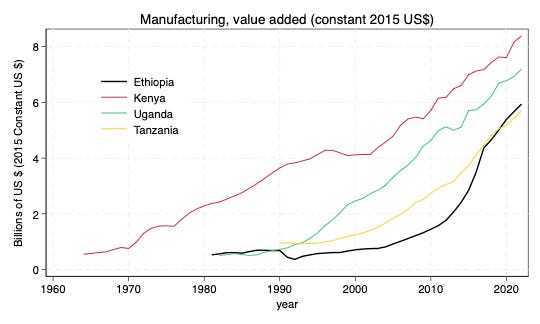
Source: World Bank data

II: The economic case for securing reliable seaport access

As shown below, over the last decade Ethiopia has quintupled its industrial output and is quickly catching up with its regional neighbors. If these trends are to continue and if Ethiopia is to attract both domestic and foreign investments into its manufacturing sector, the state must guarantee investors that they will be able to access global markets at reasonable prices. The same goes for investments in the agricultural sector, which still has a commanding share of exports. Agriculture accounts for nearly 38% of GDP (including 50% of manufacturing production), 80% of employment, and about 90% of forex earnings.

Ethiopia’s planned rail network (see below) reflects the country’s industrialization agenda (the same goes for the overall transport masterplan, including road infrastructure). The proposed lines are all designed to serve specific industrial parks. Currently the main rail network (red) terminates at Djibouti City (Doraleh Multipurpose Port), with a planned alternative route to the opposite side of the Gulf of Tadjoura (in Tadjoura). While the rail network will certainly serve domestic production and distribution of goods once completed, an equally important objective should be to guarantee high-enough international traffic volumes to pay for its construction and ongoing maintenance.

As revealed by the planned railway network below, Ethiopia’s seaport options are largely limited to Djibouti — which is cause for believing that Abiy’s comments, if he really meant them and was not just carelessly thinking out loud that he is the latter day Ras Alula Abanega, were a negotiating tactic vis-a-vis Djibouti. Given its importance for Ethiopia’s maritime trade, is also likely that Djibouti is Addis Ababa’s first choice for the location of the planned naval base.

Ethiopia’s industrial parks are in Jimma, Hawassa, Adama, Dire Dawa, Bole Lemi, Debre Birhan, Semera, Kombolcha, Bahir Dar, and Mekelle. Source: Wikipedia

Read my earlier post: Economic Development Can Bring Peace to the Horn of Africa

Lawrence Freeman is a Political-Economic Analyst for Africa, who has been involved in economic development policies for Africa for over 30 years. He is a teacher, writer, public speaker, and consultant on Africa. Mr. Freeman strongly believes that economic development is an essential human right. He is also the creator of the blog:  lawrencefreemanafricaandtheworld.com

China Fully Engaged in Africa for 2023-The Future is Trade Not Debt

By Lawrence Freeman

Ethiopian Prime Minister, Dr Abiy Ahmed with Chinese Foreign Minister, Qin Gang, in Addis Ababa (Courtesy of VOA)

For the thirty-third consecutive year, the first foreign trip by China’s Foreign Minister was to Africa. China’s new Foreign Minister, Qin Gang, the former Ambassador to the United States, traveled to Ethiopia, Gabon, Angola, Benin, and Egypt, from January 9 to 16, 2023. In addition to visiting these five African nations he was also invited to meet with African leaders at the African Union and the League of Arab States Headquarters. The stated purpose of the trip was: To deepen the China-Africa comprehensive strategic and cooperative partnership and boost friendly cooperation between China and Africa.

Friendship Remains Strong

Starting in the year 2000, China organized the Forum on China-Africa Cooperation (FOCAC), which meets every three years, alternating between China and Africa. These conferences provide a unique opportunity for African leaders and Chinese President, Xi Jinping, to discuss future economic, cultural, and political collaboration. Contrary to continued efforts by the U.S. to malign Africa-China cooperation, China and Africa have remained steadfast in their shared common interest; the development of their people.


Chairperson of the African Union Commission, H.E. Moussa Faki Mahamat, and Qin Gang at ribbon cutting ceremony at the new Africa CDC. (Courtesy of African Union-au.int)

One of the highlights of Foreign Minister Qin Gang’s visit to Ethiopia, was to inaugurate the new Headquarters of the Africa Center for Disease Control and Prevention (Africa CDC). The new Africa CDC, located outside of Addis Ababa, the capital of Ethiopia, was built by China and given as a gift to Africa.

This is a critically important contribution to Africa, a continent of one and a half billion people, which was given a very low priority for vaccinating against COVID 19, and continuously suffers from a weak healthcare system.

Foreign Minister Qin met with Ethiopia’s Prime Minister, Dr. Abiy Ahmed, and Deputy Prime Minister and Foreign Minister Demeke Mekonnen. He was the first foreign government official to visit Ethiopia following the signing of the peace agreement of November 2, 2022, that ended a two year long war in northern Ethiopia. He expressed China’s support for “Africans in solving African problems in African ways.” This attitude differs dramatically from the U.S. and Europe, who undermined the government of Ethiopia during the war. Foreign Minister Qin pledged to assist Ethiopia in its reconstruction efforts, which are formidable following the terrible damage that the country suffered in fighting to maintain its sovereignty. Additionally, he announced that China will forgive thirty million dollars in Ethiopian debt.

In December 2022, the U.S. convened its first U.S.-Africa Summit in eight years. The unspoken “secret topic” and motivation for the three-day conference was, how to counter China’s growing influence on the African continent.  

There are yet to be any “deliverables” from the U.S.-Africa Summit. While the Biden administration seems to be more focused on exporting the “infrastructure of democracy,” China is building and financing more hard infrastructure projects in Africa than the rest of Western nations combined. These projects impact the daily material needs of the African people, which is essential to eliminate poverty on the continent.

China-Africa Trade Not Debt

China’s trade with Africa during 2022 expanded to its largest single year total of $282 billion. China exported $164.5 billion to Africa and imported $117.5 billion over that twelve-month time, which represented an increase of 11% over 2021. From January to November of 2022, U.S. exports to Africa, were $28.5 billion and imports of $38.9 billion for a total trade of $67.3 billion, almost no increase over 2021. Thus, U.S. trade with Africa was approximately one-fourth that of China for 2022. If the U.S. intends to counter or challenge China in Africa, it will have to do a lot more than “exporting democracy.”

As you can see from the chart below the myth spun by Western officials and the media that China is primarily responsbile for Africa’s debt, is simply not ture. This intentionally false allegation has been refuted again and again, but Western governments continue to propagandize Africa nations that China is using a ‘debt-trap’ diplomacy to seize their resources. Chinese ‘Debt Trap” is a Myth-Biden Would be Wise Not to Continue Trump’s Attacks on China in Africa,

The total outstanding debt for sub-Saharan African nations to foreign entities totals: 454.4 billion USD. China is not even close to being the largest debt holder. China owns 79 billion USD of sub-Saharan Africa’s debt, less than one firth-17%. The debt held by bondholders, the World Bank, and the IMF, equals 286.9 billion USD,-63% of the total foreign debt of sub-Saharan Africa,

Courtesy of Reuters Graphics

Investing in Manufacturing

Contrary to Western propaganda, which accuses China of stealing Africa’s resources, China is actually expanding Africa’s manufacturing sector. This is a vital contribution since African nations suffer from an anemic production capability to add value their natural resources. A good example is the investment by Dinson Iron and Steel Company (DISCO), a Chinese steel manufacturer, who intends to invest in building a lithium battery manufacturing plant in Zimbabwe. chinese firm to manufacture lithium batteries in zim. The Zimbabwean government has wisely banned the export of raw lithium. Having its own manufacturing plant, will create jobs and improve the standard of living of Zimbabweans, since mining and export of valuable minerals does not lead to economic growth for the population.

This kind of investment in local manufacturing along with China’s Belt and Road strategy of building infrastructure throughout Africa, is exactly what is needed to assist African nations in creating strong sovereign economies.

Lawrence Freeman is a Political-Economic Analyst for Africa, who has been involved in economic development policies for Africa for over 30 years. He is a teacher, writer, public speaker, and consultant on Africa. He is also the creator of the blog: lawrencefreemanafricaandtheworld.com. Mr. Freeman’s stated personal mission is; to eliminate poverty and hunger in Africa by applying the scientific economic principles of Alexander Hamilton

African Youth Favor China’s Development Policy Over the U.S.

Africa’s youth recognize China’s contributions to the continent.

June 29, 2022

According to a recent survey by Ichikowitz Family Foundation, African youth favor China’s involvement on the continent over that of the United States.

In an article from the VOA-Voice of America, China wins battle of perception among young Africans, they report:

“Seventy-seven percent of young Africans said China was the ‘foreign actor’ with the greatest impact on the continent, while giving the U.S. an influence rating of just 67%. In a follow-up question on whether that influence was positive or negative, 76% said China’s was positive, while 72% said the same of the U.S.

“By contrast, U.S. influence has dropped by 12% since 2020, according to the survey of more than 4,500 Africans 18 to 24 years old and living in 15 countries across Africa.”

One of the primary reasons for their choices is: “Beijing’s investments in infrastructure development on the continent and China’s creation of job opportunities in African countries.” (Emphasis added)

Ivor Ichikowitz said:

“Young Africans are telling us that they are seeing tangible, visible and very impactful signs of the role that China has played in the development of Africa.”

“Albeit that there is significant criticism of Chinese investment in Africa, it’s very difficult for African governments not to value China because China is providing capital, providing expertise, providing markets at a time when Europe and the United States are not.” 

China Embraces Economic Transformation of Africa

The Journal of International Development published in May of this year, Economic Transformation in Africa: What is the role of Chinese firms? This research paper explains why China has surpassed the U.S. in favorability among African youth.

The abstract of this paper bluntly states exactly what Western geopolitical ideologies still refuse to accept:

 “Africa–China trade leads to mixed results, while Chinese investment and infrastructure construction are found to contribute positively to transformation. Chinese firms are also found to support capacity building, spillovers, and innovation in African countries.”

The authors have identified a central concept. African nations need Economic Transformation (ET), which is not equal to simplistic and false notions of economic growth measured by Gross Domestic Product (GDP).

They correctly explain the difference in their introduction:

“The process of economic transformation (ET), indicating the changes affecting the structure of an economy, is at the core of development. While GDP growth is often used as a metric for development, it simply points to an expansion of a country’s economic size, but it does not guarantee that the economy has become more diversified, resilient to shocks or inclusive. Conversely, ET, indicating a transition from an economy based on traditional agriculture to one where modern sectors take the central place, can deliver job creation, diversification, and inclusive development.

“Today, African countries face an ET gap. While many African economies have grown over the last few decades, their structure has not transformed. In contrast with other regions of the world, where the majority of people are employed in the secondary and tertiary sectors, a large share of Africa’s labor force works in agriculture and related activities, where average productivity is lower.

“When Chinese economic engagement with Africa started intensifying at the turn of the century, it raised hopes for ET. China’s extraordinary growth and poverty reduction performance could be a model for African countries; and with China as a trade, investment and development partner, African economies could hope to follow a similar path. African engagement with China was deemed particularly promising for industrialization on the continent. (Emphasis added)

Regrettably, both for the U.S., and Africa, and the rest of the developing sector, the West no longer believes in economic transformation. The U.S. in particular, is no longer devoted to fostering economic development for itself or other nations, contrary to many outstanding periods of its history. Whatever shortcomings exist in China’s relationship to Africa, China is committed to promoting real economic development i.e., economic transformation on the African continent. Yet Western governments continually attack China and its Belt and Road Initiative for assisting African nations in addressing the most critical deficiency in their economies; the lack of infrastructure and a manufacturing sector.

Many people, including so called economic experts fail to understand that money is not the basis of economic growth. The addition of all the monetary values of an economy’s goods and services measured in GDP, does not determine economic growth. The only proper, scientific measure of economy is not monetary values, but the ability of each particular mode of economic production to provide an increased standard of living to an expanding population. A physical economist  like myself understands, that it is those physical inputs that lead to an increase in the performance-output of the productive powers of labor that determines real economic growth. Infrastructure and manufacturing capacity are crucial physical inputs required for economic transformation.

That is what the Chinese are providing for Africa, unlike the West. Could that be why young Africans think more approvingly of China’s policies in Africa than the U.S.?

Read the entire  paper: Economic Transformation in Africa: What is the role of Chinese firms?

Read my earlier post: Africa Needs Real Economic Growth, Not IMF Accountants; For the Development of Africa: Know and Apply Franklin Roosevelt’s Credit Policy

Lawrence Freeman is a Political-Economic Analyst for Africa, who has been involved in economic development policies for Africa for over 30 years. He is a writer, researcher, and consultant, and the creator of the blog: lawrencefreemanafricaandtheworld.com. Mr. Freeman’s stated personal mission is; to eliminate poverty and hunger in Africa by applying the scientific economic principles of Alexander Hamilton.

South African Activist Campaigns for Nuclear Energy For Africa: Essential for Industrialization

May 22, 2022

Africa4Nuclear

The post below is provided by my colleague, PD Lawton, creator of the website: africanagenda.net

It is abundantly clear that African nations must become economically sovereign republics, and that is not possible without becoming industrialized economies with advanced agricultural and economic sectors. . For this transformation to occur, massive amounts of additional reliable, powerful energy is required. My estimations is that a minimum of 1,000 gigawatts of additional power is required. Without doubt, this will require the construction of nuclear energy plants across the continent. Listen to Princy Mthombeni, founder Africa4Nuclear

Read my earlier posts on this subject.

Nuclear Energy Challenges Western Colonial Mind-Set: Cheikh Anta Diop & John Kennedy Would Concur

Nuclear Power A Necessity for Africa’s Economic Growth

Mozambique is Obligated to Exploit Its Resources For the Development of Its Economy

Nigerian VP: Osinbajo “Climate Justice Must Include Ending Energy Poverty” Especially for Sub-Saharan Africa

Lawrence Freeman is a Political-Economic Analyst for Africa, who has been involved in economic development policies for Africa for over 30 years. He is the creator of the blog: lawrencefreemanafricaandtheworld.com. Mr. Freeman’s stated personal mission is; to eliminate poverty and hunger in Africa by applying the scientific economic principles of Alexander Hamilton.